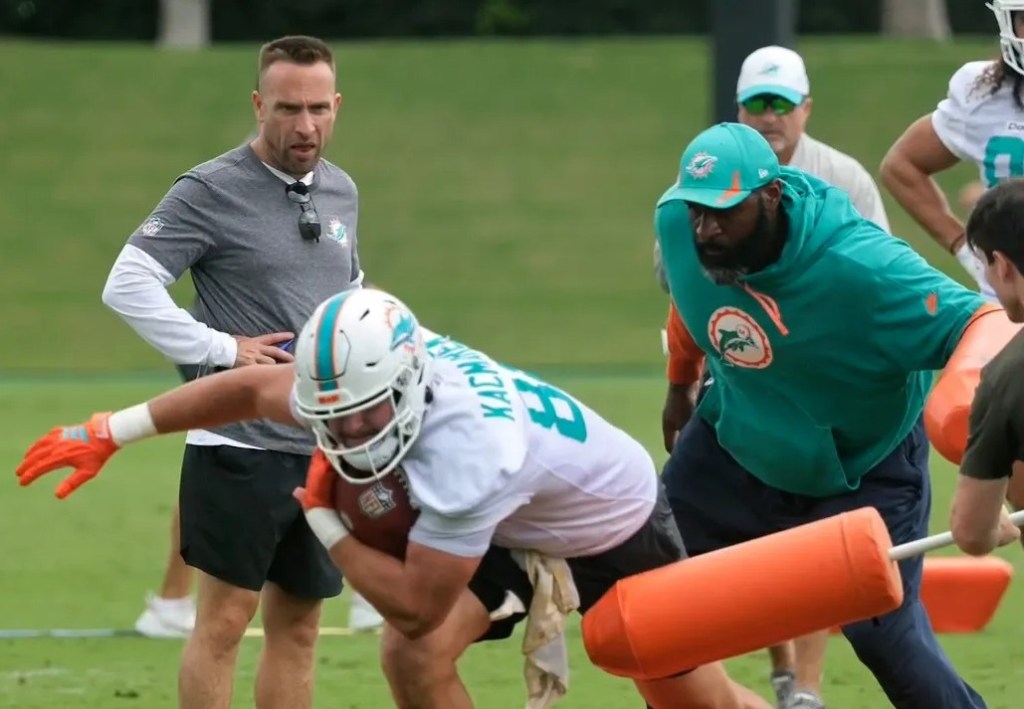
Reports that the Miami Dolphins came out in training camp in “full team” (i.e. 11-on-11) drills only — with no work in 7-on-7 (aka “skelly”) — seem like a pretty mundane thing to pay attention to, but on the contrary it’s another way Green Bay has found its way in Miami.
ADOPTING LeFLEUR’S LOATHING
Maybe first-year Miami head coach Jeff Hafley doesn’t hate skelly, but his former head coach in Green Bay, Matt LaFleur, made no secret of his passionate distaste for it while literally vowing to do everything to avoid it.
LaFleur ended the practice of using skelly and only went full team in Green Bay from day one, when he was hired in 2019.
“I want to make that clear right now. I’m not a fan of (7-on-7),” LaFleur said during the 2024 postseason. “I just think it’s not realistic. I like the quarterbacks having to feel a rush.”
For LaFleur, it primarily comes down to it being a team thing, a teaching/learning apparatus and making the best use of time.
A PERFECT FIT FOR THIS DOLPHINS TEAM
In Miami, practicing ‘full team’ is probably even more important, largely because of the youth movement Hafley & Co. are taking on.
Instead of the pace of skelly, getting in and out of plays quick, full team allows for more coaching. Mistakes happen in real time, not as something to piece together later. Things are corrected in real time.
With an inordinate number of first-year players including 13 rookie draftees and ~10 more UDFA newcomers, the teaching opportunities will likely be plentiful.
GETTING ON THE SAME PAGE
The offensive line (for example) is a unit within a unit. But linemen certainly work in concert with tight ends in blocking, and even in their rhythm and learning the cadence of a new quarterback. All this is lost in skelly.
Rookie draftee tight ends Will Kacmarek and Sedou Traore join Packers veteran H-back Ben Sims as newcomers to the offense who will get more out of lining up and completing full positional duties as opposed to being just receiving-only tight ends.
CAN’T HALF PRACTICE HAFLEY’S SYSTEM
But the group that can most use this is Hafley’s defense, hands down.
Not only does Miami’s defense feature three second-year defensive lineman in Kenneth Grant, Jordan Phillips and Zeek Biggers, its likely to be soon leaning on rookie linebackers Jacob Rodriguez, Kyle Louis and Trey Moore as well.
Hafley’s defense shows the opposing quarterback a static front, often eight defenders around the line of scrimmage and a single-high safety. Where each defender is headed doesn’t happen until post-snap and a QB has to make a read, quickly. The goal is to force mistakes.
For young players, part of forcing mistakes will be learning not to make them.
POSITIONAL VERSATILITY = MORE TO LEARN
What makes that static front work is not knowing where anybody is headed, sometimes even swapping out a dropping defensive end/LEO for a blitzing SAM linebacker.
It’s why the cover skills of Rodriguez and Louis will be valued the same as Moore’s pass rush skills. Hybrid players with positional versatility makes more for a quarterback to digest.
Moore is the best example of a player who will likely benefit from them not being in skelly. His ability to be likely play off-ball while being able to also bring heat off the edge will be what give opposing linemen fits.
Knowing when to rush and when to drop and doing it without thinking is how players play fast and bad decisions forced.
Hafley gives his defense less plays to learn but expects them to end up with expertise.
More repetition is the cure and getting that in practice by way of full team drills moving forward is yet another way the Green Bay influence has drifted south to Miami.


