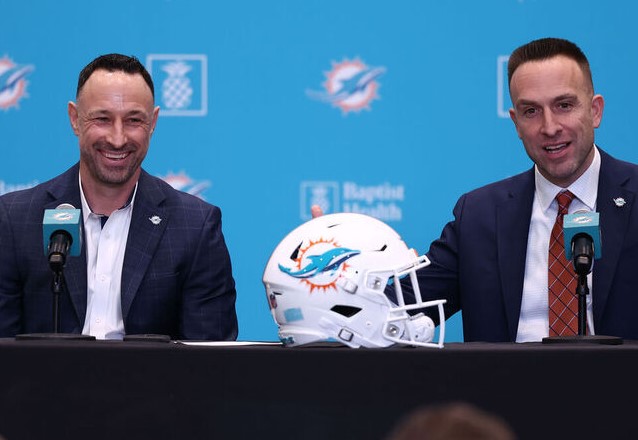
While first-year Miami Dolphins general manager Jon-Eric Sullivan definitely has a road to hoe ahead, hiring Jeff Hafley as his head coach was one thing that will presumably make his life easier on draft night.
With a roster full of holes and mercenaries, Sullivan has thus far armed himself with 11 draft picks and a whopping eight selections in the 2026 NFL Draft’s top 130 picks.
It almost goes without saying that every pick will count, but especially so in the early stages of a rebuild. So one thing that is a nice gift that Hafley affords Sullivan is a little flexibility.
In his second season in Green Bay (2025), Hafley transitioned out of a standard 4-3 and into a Wide 9 that ran a 4-2-5 75% of the time. It’s the expectation he will again in Miami and he will be in search of defenders with multiplicity.
Back in the day they called it a “tweener.” But if it’s a good thing, that player is a “hybrid.”
Last season, just four teams (San Francisco, Green Bay, Cleveland and Detroit) served up a heavy dose of Wide 9. Heading into 2026, the 49ers are scaling back on it, the Packers are not running it nor are the Lions under coaching changes, and the Browns are running it again using a new coordinator.
That leaves two teams with higher values on hybrid players in this year’s draft — Miami and Cleveland. And just like everything else in life — as we are all living — it’s all about supply and demand.
If demand is limited, supply will be more plentiful. And how does that help Sullivan? Miami can prioritize positions that will presumptively move faster on draft day if that is also a need for the Dolphins, while understanding they may have the ability to still land their player a little later.
WHY HAFLEY WANTS MULTIPLICITY
Last season, then-DC Anthony Weaver likely saw the limitations his unit had on the back end, which led to a lot of pre-snap motion and blitzing to try and limit his defensive backfield’s time exposure. It worked at times, but moreover Miami had the worst completion percentage allowed of any defense in the NFL last year.
Conversely, Hafley likes to show a look pre-snap and stay in it until the play is in action. But in the meantime, opposing quarterbacks have to consider who is rushing and who isn’t because Hafley loves simulated blitzes. And this is where a hybrid player comes in.
A one-dimensional player may not be able to give a look that a quarterback considers likely, which leads to less post-snap thinking. A player with multiplicity, however, can line up as if he’s going to rush on the play, only to dip out and leave a different player in charge of pressure.
In this scenario, without the experience or athleticism to rush, Miami is stuck with an off-ball linebacker. But if that player is one who is maybe between sizes and had success as a pass rusher in college, they can both get it done in pass rush and in dropping off into coverage.
PLAYERS WHO FIT
Aqua & Coral Report‘s 2026 Dolphins-focused Draft Guide comes out April 7, so there will be much more information there.
But an example of one player Miami has met with recently who fits this description is Texas linebacker Trey Moore.
Moore is 6-2, 243 but with sub-standard arms from a Dolphins perspective (31 5/8 inches) for an edge rusher, which is what many teams have him listed.
At the combine, Moore ran a 4.54 40-yard dash with a 38 1/2-inch vertical and a 10-0 broad jump, so his athleticism is more than a fit for edge, but also bodes well for him as a weakside linebacker.
Texas used him more off-ball last year and it was a success. But what will set him apart is his 30.5 career sacks between UT and UTSA, something that would come in handy when a QB surveys the situation and realizes that the Will is now lined up over a guard or outside the tackle.
Due to this inconsistent mix of size and speed for an edge, Miami may be able to land itself a player who posted 140 pressures across five college seasons somewhere likely on day three.

 Aqua & Coral Report