

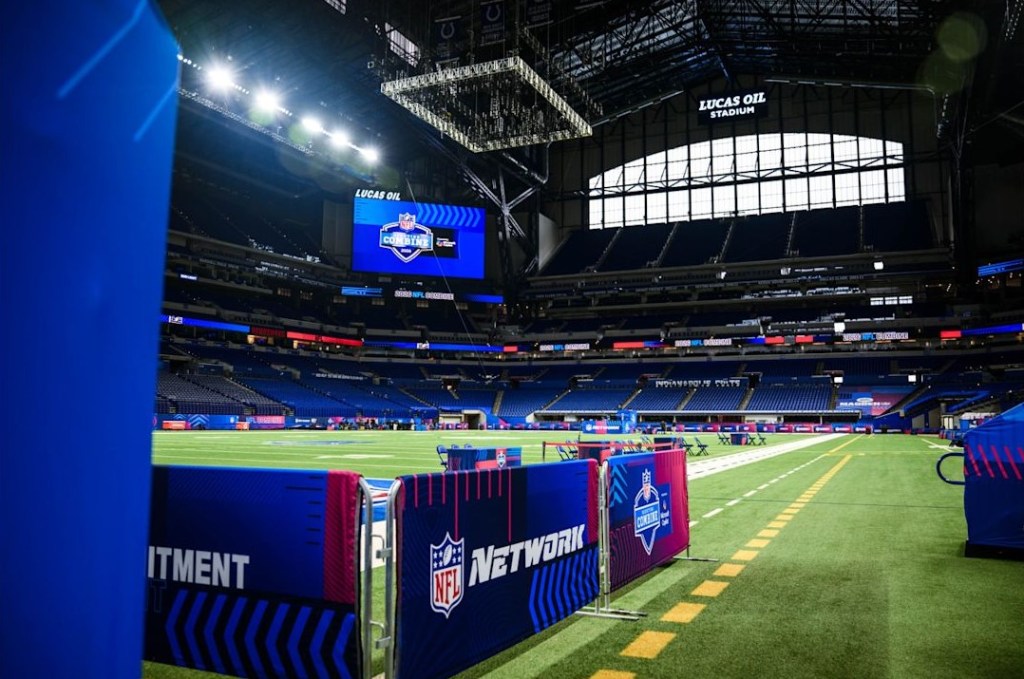
Halfway done with on-field testing and individual drills, day three of the 2026 NFL Draft Combine gets under way in Indianapolis this afternoon (NFL Network, 1:00 p.m. ET).
Saturday’s session will feature everyone’s favorite, the offensive skill players. Quarterbacks, running backs and wide receivers will undergo on-field testing today.
The Miami Dolphins have extensive needs at wide receiver and obviously quarterback, two positions diametrically opposed in terms of the available talent this year. Just one quarterback – Indiana’s Fernando Mendoza – is can’t-miss in terms of starter quality, while the rest of the class is heavy on question marks.
Receiver on the other hand is one of the deepest positions in the draft with talent available well into Day 3 of the draft.
It is not a great running back class and fortunately, Miami doesn’t have tremendous need compared to the rest of the roster with Devon Achane, Jaylen Wright and Ollie Gordon II all under contract.
The Miami-related questions surrounding combine day three primarily have to do with which QB may be a good late-round addition for QB competition and which receivers fit what GM Jon-Eric Sullivan and offensive coordinator Bobby Slowik have in mind.
A WIDEOUT BONANZA
This year’s draft isn’t one that’s heavy on potential superstars in the receiving department, but it does have good talent ranging from the first through the fourth or fifth round of the draft, which would be exceptionally deep any year.
Earlier in the week, Sullivan made it clear that the Dolphins will be looking to add size to the current group of wideouts, an ambition that will not be too hard to attain this draft.
“We will make a conscientious effort to maybe be a little bigger in that room,” Sullivan said at the NFL combine Tuesday. “To say we’re going to have a room full of 5-9 guys would be a lie.”
Prospects who have stood out on tape and Dolphins evaluators will likely focus on in testing include Arizona State’s Jordyn Tyson (6-2), Georgia State’s Ted Hurst (6-3), Washington bruiser Denzel Boston (6-4) and USC’s Ja’Kobi Lane (6-5), to name a few.
But the player who could start seeing a lot more attention and should be of interest to Miami is North Dakota State’s Bryce Lance.
At 6-3, Lance is outstanding at contested catches. His hands are amazing. But what he brings to the table and what scouts will be watching for is his speed.
Lance shows separation that most of the other taller receivers just don’t have. The younger brother of quarterback Trey Lance, Bryce’s name could become more familiar by day’s end. His tape is fantastic and last year he posted 1,079 yards on 51 catches, a whopping 21.2 yards per reception.
Below are his highlights from the FCS playoffs the last two seasons. Impressive stuff at crunch time.
SNEAKING UP DRAFT BOARDS?
The running back class is nothing like the deep, talented class that presented in 2025, but there are some backs who might fit the size narrative Sullivan wants to subscribe to in Miami — beef. There’s one prospect in particular whose path likely limited his exposure, but he could be the type back who could excel in a (Mike) Shanahan system.
Arkansas’ Mike Washington Jr. went from Buffalo (2021-23) to New Mexico State (2024) before winding up somewhere in the middle for his 2025 season in Fayetteville.
Washington runs like a 6-2, 228-pound version of Frank Gore with the patience of LeVeon Bell. He runs with great pad level, especially at his size and is patient, often letting blocks materialize before planting to go. He also has a nice burst when he makes his decision.
Washington ran for 1,070 yards on 167 carries (6.4 avg) with eight TDs in 2025 and showed good hands out of the backfield. He’s a punishing runner who shows the long speed on tape, so it will be interesting to see what he churns out testing-wise in Indy.
Washington was originally considered a day three player but has been on a steady climb since Senior Bowl week. A good 40 time and he could be looking at going as high as the second round, which may be too rich for Miami’s blood, but a player to watch.
A PAIR OF SIGNAL CALLERS WHO CAN SCOOT
Two intriguing players though are Arkansas’ Taylen Green and another NDSU prospect, Cole Payton.
The reason we find these two players of interest isn’t as simple as just “QB prospect.” Each would be considered a long-shot NFL starter at this point, but both have requisite skills to find the field and contribute in the NFL whether they end up a starter or not.
Green is a glider when he runs, a la Vince Young or Randall Cunningham for ye old heads. The threat of him taking off when a play breaks down is one of defensive coordinator nightmares. It forces a defense to play 11-on-11, something Miami’s offense hasn’t done in years.
Green is also big (6-6, 224) and has a good enough arm, but turnovers and semi-sloppy play at times are a concern to the point you wonder if there are processing issues. He threw 11 interceptions and lost five fumbles last year.
In fairness, Green was on a bad team with a bad line in 2025 that fired its head coach midseason. Regardless, this is a QB prospect who makes you start thinking ‘combine’ the first time you watch him spin to escape a collapsing pocket.
Last season, pre-combine and pro days, Jaxson Dart was widely held as around a fourth round quarterback by respective experts. His testing and pro day set him apart though, he was a first round pick and had a promising freshman campaign in New York.
With his combination of size and athleticism, Green could put up an all-timer Relative Athletic Score (RAS) which will rank with pretty much any skill position player (just a hunch). He should be one of the stars of the combine. If some coach can get the game to slow down for him in the pass department, he could be a star.
Payton is going to draw comparisons to Taysom Hill. He’s 6-3, 233 and he sliced up FCS defenses as a runner. His throwing motion is not pretty though and it’s hard to tell how that will hold up at the next level. That said, he throws outs with pace and can make a layered throw so maybe you just live with it. Either way, third and short would be his wheelhouse, no matter who Miami’s primary signal caller is.
In a sub-par quarterback year, finding a QB athletic enough to be developed in more than one area that could help the team might be worth exploring for Miami, a team that will be young and in a bit of a job fair in 2026.
A POSSIBLE QB SLEEPER
There are so few quarterback prospects in this draft that most have been covered at length. Ironically, the one who may be the most accomplished as a passer the last few years has drawn barely a peep.
This year’s possible Tyler Shough could be Connecticut QB Joe Fagnano (fan-YONN-oh) just completed his SEVENTH college season after playing four seasons at Maine before his final three with the Huskies.
Will keep it brief. Fagnano is 6-4, 225 and his combined passing statistics for 2024 and 2025 are: 405-of-619 (65.4%) for 5,079 yards, 48 touchdowns and just five interceptions. Last year he threw 28 TDs and just one pick.
Sully said he doesn’t want a player to sign his second contract at 30 years old, but if you have a guy available at low cost with possible high production, maybe this is the one you draft this year.
WHO TO WATCH, COMBINE DAY 3
Below is a list of Day 3 combine prospects the Dolphins should keep an eye on, based on Aqua & Coral Report’s pre-combine evaluations:
Joe Fagnano, UConn
Taylen Green, Arkansas
Cole Payton, North Dakota State
Sawyer Robertson, Baylor
RUNNING BACKS
Jonah Coleman, Washington
Roman Hemby, Indiana
Robert Henry Jr., UTSA
Emmett Johnson, Nebraska
Jeremiyah Love, Notre Dame
Le’Veon Moss, Texas A&M
J’Mari Taylor, Virginia
Mike Washington Jr., Arkansas
WIDE RECEIVERS
Vinny Anthony II, Wisconsin
Chris Bell, Louisville
Skyler Bell, UConn
Denzel Boston, Washington
Chris Brazzell II, Tennessee
Josh Cameron, Baylor
KC Concepcion, Texas A&M
Omar Cooper Jr., Indiana
Malachi Fields, Notre Dame
Ted Hurst, Georgia State
Bryce Lance, North Dakota State
Ja’Kobi Lane, USC
Makai Lemon, USC
Elijah Sarratt, Indiana
J. Michael Sturdivant, Florida
Carnell Tate, Ohio State
Jordyn Tyson, Arizona State
Reggie Virgil, Texas Tech
QB/RB/WR TESTING BENCHMARKS
Below are the testing benchmarks to look for when watching quarterbacks, running backs and wide receivers at Saturday’s NFL Draft Combine:
40-yard Dash
Cornerbacks (4.49 average, <4.39 elite)
Safeties (4.54 average, <4.45 elite)
Tight Ends (4.75, <4.55 elite)
10-yard Split
Cornerbacks (1.58 average, <1.52 elite)
Safeties (1.59 average, <1.54 elite)
Tight Ends (1.63 average, <1.58 elite)
Short Shuttle
Cornerbacks (4.17 average, <4.05 elite)
Safeties (4.25 average, <4.10 elite)
Tight Ends (4.37 average, <4.20 elite)
Three Cone Drill
Cornerbacks (7.00 average, <6.85 elite)
Safeties (7.08 average, <6.90 elite)
Tight Ends (7.17 average, <6.95 elite)
Broad Jump
Cornerbacks (10-2 average, 10-8+ elite)
Safeties (10-3 average, 10-9+ elite)
Tight Ends (9-7 average, 10-4+ elite)
Vertical Jump
Cornerbacks (36-inch average, 40-inch+ elite)
Safeties (35.5-inch average, 39-inch+ elite)
Tight Ends (33-inch average, 37-inch+ elite)
Want to chat Dolphins football and the draft? Have a take or question on a certain prospect? Follow the Aqua & Coral Report on Twitter at @AquaCoralRep and fire away.

