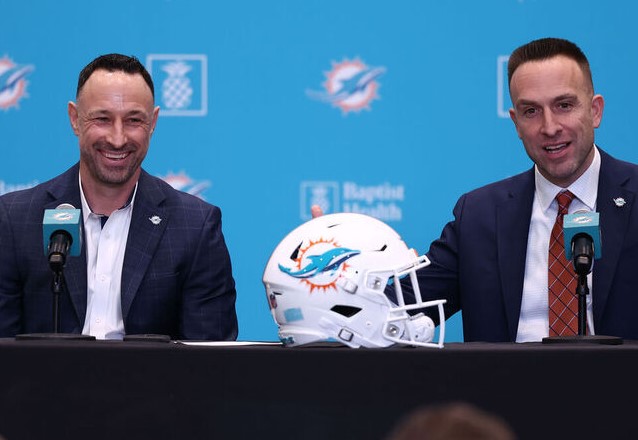
The Miami Dolphins haven’t yet had a full team meeting or even named half its coaching staff since naming Jeff Hafley the team’s new head coach on January 19. There is already enough in place, however, to have a rough idea of what Hafley’s Dolphins may end up looking like schematically.
Last weekend, the team announced its first big coaching hire under Hafley as Bobby Slowik was retained and promoted to offensive coordinator. Slowik joined the Dolphins in 2025 after serving two years as Houston’s offensive coordinator and coached with Hafley in San Francisco.
While a defensive coordinator has yet to be officially named, the identity of the Dolphins defense is already known as Hafley will be running his defense and calling plays in-season. The incoming DC will be primarily responsible for defense install in the offseason, while Hafley focuses on the team as a whole, especially in year one.
HAFLEY’S DEFENSE WILL BE A CHANGE
Dolphins fans who pay that close of attention will be in for mild culture shock going from Anthony Weaver’s 2025 style to what Hafley likes to do.
Former coordinator Joe Barry’s defense in Green Bay was much like the 80’s Shula-led, Bill Arnsparger Dolphins defense in theory – bend but don’t break. Hafley on the other hand wants players to play at max speed and agression, and looks to achieve it through pre-snap and relative simplicity coupled with detailed and continuous coaching. Think less post-snap is the goal.
Below is a look at one of Hafley’s concepts last year in Green Bay:
The schematic foundation will be a 4-3 look with a single-high safety. In a league of nickel (4-2-5) defenses, Cover 2s and Quarters, Hafley will run Cover 1 sets using man and Cover 3 in zone. It often has the safety to play closer to the line of scrimmage. It’s one reason the team may consider a player like Ohio State’s Caleb Downs in the first round, when otherwise a safety would not be a first thought at pick 11.
The defensive front in Hafley’s scheme is built on getting upfield and creating chaos in the backfield. Whereas Weaver tried to achieve this through a multitude of blitzes – a league-leading 31% of the time – Hafley relies on his four-man front to get a push. The Packers were 25th last year in blitz rate (21%).
The Hafley defense gets there using disguised looks and simulated pressure out of its base defense. For example, it will show a six-man look only to wind up sending four. The question usually is which four, which creates havoc for blockers and can lead to quarterback confusion, i.e. turnovers.
On the back end, Hafley prefers his defensive backs press. He asks for few adjustments in an effort to play fast, with his stated mantra being “precision over complexity.”
Miami is in dire need of secondary talent for Hafley to have success so fans should be patient with results in 2026 as the cupboards are practically bare.
HIGHS AND LOWS OF HAFLEY’S DEFENSE
Nicknamed “The Wizard” by safety Jordan Fuller when he was DC at Ohio State, Hafley has made it clear – he doesn’t care how many yards his defense gives up. He cares about points allowed and turnovers forced. In his first season as coordinator, Green Bay was second in the league in turnovers forced with 31.
So, in playing press, man and leaving a four-man front to get home in the backfield, the aim for Hafley is creating chaos while his team is operating at high speed.
The goal is to hold the opposition out of the end zone or take the ball away before it gets into scoring range and do so by eliminating easy plays. For example, Hafley would prefer an opposing offense take a chance on a deep ball than get an easy underneath pass or five-yard run while cruising down the field and eating clock.
The flip side of his approach can be struggles in certain areas.
The high-risk/high-reward approach can lead to long plays and if a team can’t cover, it will prove problematic. Aside from short passing, Hafley’s system can also sometimes be vulnerable to a power rushing attack.
Regardless, count on the 2026 version to be a work in progress. It will be fair based on resources.
MIAMI’S OFFENSE STAYS THE SAME, BUT NOT THE SAME
It would easy to project that Slowik would just run it back with Miami’s 2025 scheme after spending time last year on staff as Mike McDaniel’s senior pass game coordinator.
And Slowik cutting his teeth in Kyle Shanahan’s version of the same offense (2017-2022) would suggest the same.
But Slowik got his start under Kyle’s father, Mike Shanahan, and there is a difference between father and son when it comes to the basic tenets of the offense. Like Hafley on defense, Mike Shanahan’s offense liked perfecting simplicity while Kyle’s is a more complex version of his father’s original.
Slowik will likely try to produce a version that combines the two.
Slowik gained notoriety in 2023 when he helped lead Texans QB C.J. Stroud to an NFL Offensive Rookie of the Year season. But take a look at the Mike Shanahan legacy with running backs – it is highlighted by producing 1,000 yards out of just about any back they threw back there, which must appeal to Hafley.
“There are certain core beliefs that I really do believe in like running the ball and being really physical up front. So that even when they know we’re going to run the ball, we’re still going to run it well.” -Jeff Hafley, 1/19/26
In 14 seasons with the Denver Broncos, the senior Shanahan helped produce a whopping ELEVEN 1,000-yard rushers and even the most astute NFL fan could likely not name or even remember them all.
Hall of Famer Terrell Davis accounted for four of those seasons. Reminder, he was a sixth-round pick. Former ‘Canes legend Clinton Portis accounted for two, while former marine Mike Anderson (2), Reuben Droughns (1), Olandis Gary (1) and Tatum Bell (1) accounted for the others.
None of those players were selected in the first round.
“I always give a ton of credit to Mike Shanahan,” Slowik said in 2024. “(He) knew how to teach coaches how to coach players and teach players and just hammer in scheme and hammer in detail.”
HOW SLOWIK HAD A LEG UP WITH HAF
The first debate post-Slowik’s appointment as offensive coordinator was primarily regarding his acclaim as a quarterback “guru.”
C.J. Stroud slid under Slowik after initially being fantastic with him, and most recently, Tua Tagavailoa struggled are the common complaints.
What isn’t debatable is that Miami employed too many coaches on offense surrounding the quarterback position to reliably know, as an outsider, who was responsible for what or, as relevant, how much of that slide was on the player himself.
Don’t forget that Slowik was around for the same development in Washington that Mike McDaniel was a part of with Robert Griffin III. He was there for Brock Purdy’s transition from “Mr. Irrelevant” to the 49ers unquestioned leader after Jimmy Garapolo went down following a hit by former Dolphins end Jaelan Phillips.
With second-year player Quinn Ewers currently atop the depth chart at quarterback and the likely addition of a rookie in the next two years, development had to be on Hafley’s mind when including Slowik as a candidate.
But what probably sealed the deal was something Mike McDaniel could never provide: Slowik got his start under Mike Shanahan with Shanahan insisting on him first learning from the defensive side of the ball.
Hafley and Slowik coached defense together in San Francisco before Kyle Shanahan pulled him over to the offensive side.
“I want an offense that does the things that give me the most trouble as a defensive play-caller,” Hafley.
There are few better ways to understanding what gives an offense headaches than having been a player or coach on the other side of the ball. That perspective from Slowik will also likely be an aid to Hafley in communicating how an opposing offense might want to attack his defense.
SOFTWARE UPDATE
While Slowik will certainly be looking to run the ball more and creating his version of the offense, there is some comfort level to having him been on staff last year.
Most Dolphins fans noticed the evolution of Miami’s offense from the jet-sweeping, high flying aerial attack of 2023 to the one stymied by defenses two-high safety looks by mid-2024 and into ’25, forcing the eventual creative adaptation to the run game and utilizing a sixth lineman at times. Those updates to the Shanahan system will not be lost on Slowik.
McDaniel is/was no doubt a brilliant offensive mind. He was seemingly not, however, good once the game went off script. Hopefully Slowik learned through observation in 2025 because unfortunately, his offenses were not good in Houston coming out of halftime, same as Miami’s in 2025. Houston was 20th in 2023 and 26th in ‘24 in third-quarter scoring.
It will likely be the case that the offensive terminology will be easier in transition than if Miami was to start fresh, with a new coordinator and new philosophy.
Should Slowik stick more with a Mike Shanahan-type approach, it will take time for the personnel to catch up with theory and Miami faithful should expect struggles (on both sides of the ball) in 2026. With that said, new general manager Jon-Eric Sullivan noted that the team identity overall will likely lend itself to a new direction and intent – power football – so there will be things to watch in terms of weekly progress and in the type of player the Dolphins will seek.
“We’ll build this from the inside out,” Sullivan said. “I think you have to make sure that your line of scrimmage on both sides of the ball is big, tough, resilient and that there’s depth so that you can survive the injuries.”
If the plan plays out the way Sullivan and Hafley say they want it to, Don Shula is smiling somewhere because the style and look this franchise is going to start taking on haunts of the style and look he once employed in the 70s.
Built for the postseason.
One can only hope.
 Aqua & Coral Report